Your Cart ()
Loading cart contents...
Your cart is currently empty.
Your cart is currently empty.

Nothing about my trip to Edinburgh had gone as planned. I woke up to a text message from The Trainline telling me my train was cancelled, with only baffling and contradictory information about what to do next. I joined a stressy group-chat with the rest of my party. We agreed to try and get there anyway. Within an hour we were dashing across the concourse at Kings Cross along with the passengers of 3 other cancelled trains, and managed to squeeze ourselves along the aisles, wobbly gangway connections and vestibules of the 10.03 – one of the only trains which was still travelling on the east coast route that day. The journey – or better to say the whole morning – slightly left me feeling like I’d been whizzed up in a blender, so that when the train finally pulled into Waverley station, it was almost a surprise to find the whole group waiting together on the platform with their bags. We walked out into the chilly sunshine by the Scott Memorial. The travel chaos was over, it wasn’t a catastrophe, and we really were in Edinburgh.
Most importantly, I’d arrived in time to still catch up with Clare. Let me explain..
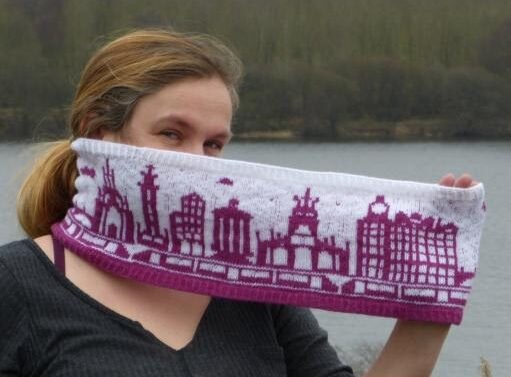
There’s a pink stripey bandana, that’s hung up here in the shop with the Kinross 4ply lambswool but unlike other swatches we have with yarns around the shop, it’s not always easy persuading people which yarn it’s been knitted in.
The scarf isn’t just smooth. It has an astonishingly soft and felty peach fuzz on the surface which gives it an almost cashmere like quality. Meanwhile the skeins of Kinross 4ply which hang on our pegs alongside the sample, whilst perfectly pleasant to the touch, keep that downy bloom as a closely guarded secret. There’s an easter-egg like mystery to this transformation. The surprise is in there, and you will find it, but you won’t discover it until you wash your work.

My trip to Edinburgh for the 2026 Woolly Good Gathering was my opportunity to meet up with Clare Hutchinson, the wool maker behind Wee-County’s Kinross 4ply, to get to the bottom of the Kinross mystery.
Why is the yarn in the skein so unrecognisable from the way it is once its been knitted and had its first bath?
Clare refers to it as greasy wool and its story goes back to a chance encounter she had with some coned lambswool from JC Rennie’s mill in Aberdeenshire.
“they went through a period when it was hard to get hold of it in balls, so I started getting it on cones instead,” she explains.
Some background about wool processing is helpful here. Ordinarily the balls of hand knitting yarn that we buy off the shelf, have been scoured and steamed in the mill after spinning, before balling. That washing process removes the lanolin and other carding oils which are added to the fibre prior to spinning. By contrast coned yarn doesn’t get scoured in the same way. The oils which have helped the fibre through the spinning machinery are left in coned yarn so that they can continue to play a useful role in easing the yarn through the knitting machines which it’s headed for next.
The yarn Clare knitted with from JC Rennie’s cones was exactly the same as the balls except that it hadn’t had the oils washed out of it. And when she washed her work after finishing knitting, she discovered something quite unexpected. It bloomed and fuzzed out in a way which was quite different from the wool she’d previously used from the mechanically scoured balls.
So when Clare found herself down the road with the spinners at the Todd and Duncan woollen mill, devising her own-label Kinross range of wool, she wasn’t at all put off when they explained they didn’t have the processing power to do the scouring there and that it would have to go to Yorkshire for scouring. As Clare says,
‘Why would you add on those miles and expense, when the machine scoured stuff comes out quite dry… I just love that I finish knitting, and I wash it, and it becomes this amazing thing... Everyone tells me my stitches are so even. I tell them, not when I first knit them! ..With fairisle particularly, which my first love, you’ve knitted all the colours next to each other, and when you wash them, the stitches melt into each other, and it becomes this sort of picture which felts together rather than individual stitches of different colours. And I just much prefer the feel of it.’

The decision was made. Kinross 4ply was not going to be steamed and scoured before it left the mill. It would keep the oils in for knitters to wash out later on.
She goes on, ‘I remember chatting to [Glasgow based designer] Carrie Westerman, and she said I’ve been trying to tell people to knit with greasy yarn. There are so many yarns which are lovely in the hank, and then you’re disappointed when you knit them up. With greasy yarn it’s the opposite!‘
There’s no doubting Clare’s love of her greasy lambswool and the care that the mill folk at Todd and Duncan have taken in spinning it, but for her beloved Kinross 4ply to really work, she was going to need a lot more knitters to believe in it too. I asked her how she got people to make that leap of faith..
‘It’s been something that I’ve had to build slowly over time. I had to persuade people to knit with the yarn, to try it. And when they do, they love it, and they come back for more.
I thought about my first encounter with the yarn when I’d been in Edinburgh last year for the same wool show, and how I’d done just that, how much I’d enjoyed discovering its magic bloom, and how remarkable that I was back here now sitting with Clare, learning about how the yarn is made. I also thought about the madness of the way the day had started out, with all the chaos at the station and on the train.
It seemed a lot more than 400 miles away.
With grateful thanks to Clare Hutchinson for making the wool and persevering with it, and for taking the time to tell me all about it.