Your Cart ()
Loading cart contents...
Your cart is currently empty.
Your cart is currently empty.
‘I hand spin a sample, as close as possible to what I want and that’s what they work on. The softness has to do with the amount of twist that you add to the yarn when you’re spinning. And of course the quality of the wool itself.‘
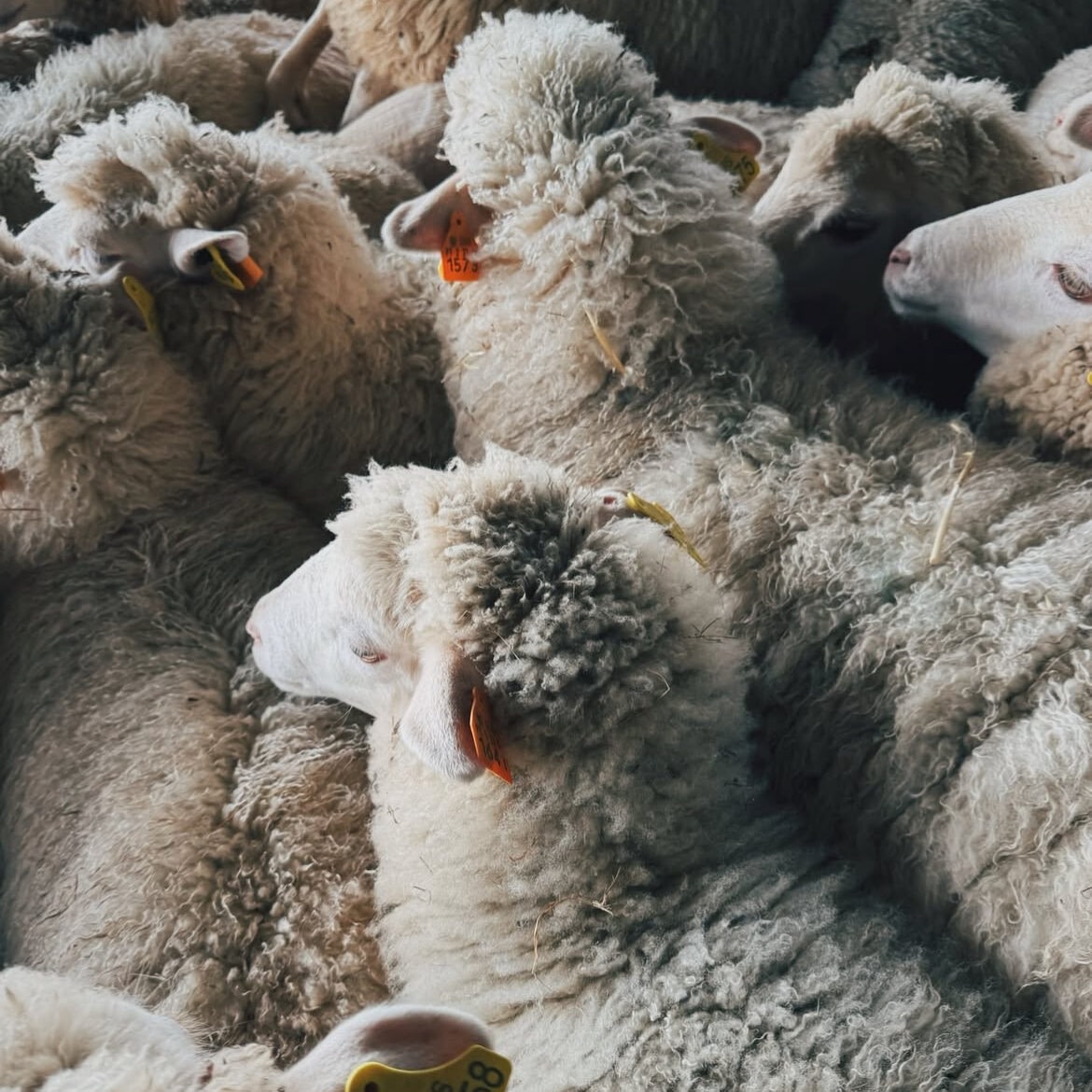
We’ve taken delivery of several kilos of Rosa Pomar’s latest yarn, Matiz. It’s a great bear-hug of a yarn. Air-filled plies of Portuguese sheep’s wool loosely twisted into a super-soft and chubby yarn wound into plump balls with an irresistable squeeziness. We are squarely in the company of a proper crowd-pleasy-winter-softy.
I’m talking to Rosa over Zoom from her place in Lisbon, so she can explain how Matiz came to be..
‘It’s been a long time since I wanted to make a heavier weight worsted yarn,’ she explains. ‘At first I was working with another mill and they had the right machine, but they didn’t want to use it because it was too old. Then they went into bankruptcy like many mills around here. More recently I’ve begun working with a new worsted mill where we make Mondim and Vovo.. And the guy at the mill also had the machine that was needed for a thicker yarn.. I’ve been trying to to convince him for ages. Now, like with most mills, they are in a bad situation.. He needs more work. So finally he said., ‘OK, let’s let’s do it!’

Matiz is the latest chapter in Rosa’s long history of not taking No for an answer, and of the knitting community’s love of her yarn, proving her defiance was worth it. Every single time.
Looking around the shop today, with tray after tray of richly earth toned balls of Portuguese wool, their varied and characterful (sometimes also slighlty grass mixed) plies, wound and labelled with Rosa’s inimitable hand-illustrated ball bands, it can feel like Portuguese wool is a main stay of our hand knitting world. But it’s worth remembering that before Rosa made up her mind to start producing yarn with Portuguese sheep’s wool for hand knitters a decade ago, no one else was doing it. No one at all. There was no shortage of yarn being milled in Portugal – just not from local flocks of sheep – the fleece was coming from New Zealand and South America.
Now with Rosa Pomar’s yarns amongst the most popular we’ve ever had in the shop, and an almost cult-like international following, it may seem like her work is done. The wool finally has the recognition it deserves – right? As Rosa explains, things are not that simple..

‘Look, people like you and me are surrounded by wool. We open Instagram and it only shows amazing people doing amazing work with wool.. it creates a totally distorted perspective of what is going on. Less than 1% of of the textile fibres used in the world now are wool. Less than 1%! Synthetics were up to 88% in 2025. The only scouring mill that we have in Portugal is probably going to close down. It’s an old family owned business… The world has changed and they didn’t.. And if the scouring mill closes, I will have to take my wool to Spain for scouring…That is 300 kilometres more than I’m doing now. Perhaps it’s not that serious a distance, but in a symbolic way it is. It’s so sad because for the first time in our history we will not be able to process our own wool locally.
As Rosa laments the extra 300 kms her yarn will have to travel for scouring and combing, I’m reminded of a conversation with a wool maker who explained how the vast majority of Superwash processing that British yarn goes through, happens in South America and China. This means it’s fairly certain that the British Wool on the label of superwash treated woollen garments, hides a 5000 mile detour that the yarn has made to China or Peru, between getting spun and finally being labelled British when it returns. Rosa’s 300 km production circle sensibilities come like a blast of fresh air.
From scouring and cleaning to combing, Rosa talks me through the systematic decline of local wool production capacity in Portugal, how family businesses are disappearing in the face of globalisation pressures and the world’s appetite for cheap synthetics. And she’s typically clear about what’s needed..
‘We need wool to be a lot more political than it is now, and we need to make people like the knitters realise… What I buy is less than 1% of the entire Portuguese fleece. I was doing the math the other day and I worked out that we’re throwing away about 3000 tonnes overall every year just in Portugal. It’s insane. When we we see these small businesses doing beautiful things with local wool, it’s ok, but it’s really important to talk about how small it still is. If we don’t get the fashion brands to work with wool, all the mills in Europe will close within couple of years. They’re closing down one by one. We need to start pressing for more accountability on what fibres people are selling at the festivals… Because it’s not a wool festival if people are selling polyester. We need to know, ‘Is it local wool?’ We really need to talk about this. It’s not easy. But if we want to make a difference, we really need to.’
Here is Rosa’s defiance back again but there’s more to it than that. A momentary crack in her voice as tears well in her eyes, make it plain that this is also deeply personal and emotional. The years of study and hard work she’s put into her understanding of Portuguese textile heritage, her intimacy with the fibre of her beloved breeds of Portuguese sheep, her knowledge of traditional processes for making yarn and how all of that links to the ecology of the land, and the economic environment that determines whether livelihoods will thrive or die – it all links up.
Rosa says, ‘It’s the environment. It’s the world that we live in and it affects us all. It’s about making it better. This is really it. It’s not just about my business anymore. It’s a cause.‘
With grateful thanks to Rosa Pomar, not only for her time to do this interview, but for the inspiration and motivation she has given this shop, for the wonderful Portuguese yarns she has made and taught us all to love, and for her courage in continuing to fight for a future for real wool, the people, the land and the animals.