Your Cart ()
Loading cart contents...
Your cart is currently empty.
Your cart is currently empty.

It was whilst she was out on a cardigan-fishing expedition on Ravelry that Brontë came back with this beauty by Amy Chritoffers. The pretty knit-purl herringbone decoration and that properly boxy shape were ticking all her pattern boxes – until she mulled over the gauge and discovered that she might have a problem.
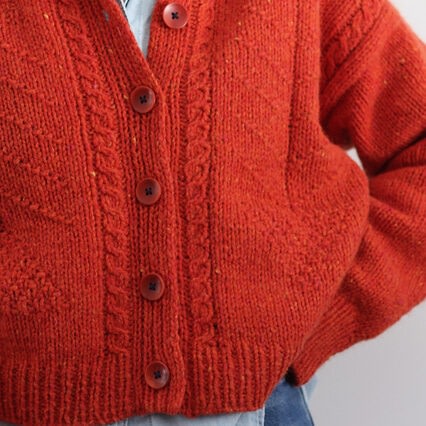
Christoffers was calling for a generous 15 stitch gauge to get a balanced-but-firm fabric, based on working with a strand of worsted plus a strand of mohair-silk blend lace. If only she she could make it work without the fluff. Not only was she worried that it might be an overheater, it was just, well, fluffier than she really wanted it to be. But a 15 stitch gauge without any help from a strand of mohair turns out to be a trickier ask than you might expect, for in spite of working in London’s premiere yarn store for niche knitters, she couldn’t pinpoint a single fluff-free way of getting the gauge: The worsteds, even the heftier ones, were too light. The chunkies, too heavy.
The solution, she decided, was a lace-weight without the fluff. The 15 stitch gauge was both too elemental to the fabric to ignore, and too nuanced to be fudged. She called a high level meeting of Wild and Woolly’s Procurement Department to discuss the crisis of the missing yarn. They unanimously agreed that it was high time the shop found an appropriate fluff-free lace weight option for this too-long-ignored niche group of knitters who require a strand of ‘something extra without the fluff’. Shade cards and sample skeins started arriving in the post. Brontë began swatching – double stranded, single stranded, varying gauges, alternate couplings with other yarns. We perused pallettes and stroked fibres and finally made a decision.
And about 2 months later (these things take time after all) John Arbon’s Seafarer Lace arrived in Clapton from north Devon: A 300m per 50g blend of west country sheep’s wool with a little silk, dyed in the wool in the typical JA way so that each skein is a heathered mix of many colours, with the silk adding just the right amount of sparkley lustre.

It may have started out as an idea for a fluff-free ‘extra’ strand, but seeing and handling the skeins as we unpacked, was quickly taking us in an are-you-thinking-what-I’m-thinking even nichier direction – Yes, it’s very very thin but oh my, it would make a beautiful summer knit, worked on its own.
As luck would have it, the new spring issue of Laine Magazine had also recently arrived from Finland. I grabbed a copy and began looking at the gauge notes for the different Patterns.

The apparently bulky waffle stitch texture of this Sara Ottosson half-placket blouse, masked an unexpectedly light weight fabric. I was definitely going to be on thinner ground with the Seafarer – 20% thinner to be precise, but something in those pillowy slipped stitches made me think the waffle wouldn’t mind. 5cm of swatching later, and I was convinced.
And Brontë’s Herringbones? It’s still in the queue and will almost certainly happen before the year is out, but as is the way with knitting fishing expeditions, there were various other distracting fish in the sea. Meanwhile, I haven’t looked left or right since casting on with my single strand of Seafarer. It may be the thinnest yarn I’ve ever knitted with, but 3 weeks on and I’m about to cast off the body and begin the sleeves. My best guess right now is that I’ll have used a grand total of 250g of yarn by the time its finished, which will probably also make it the lightest sweater I’ve ever made.
This yarn has totally and unexpectedly stolen my heart.